
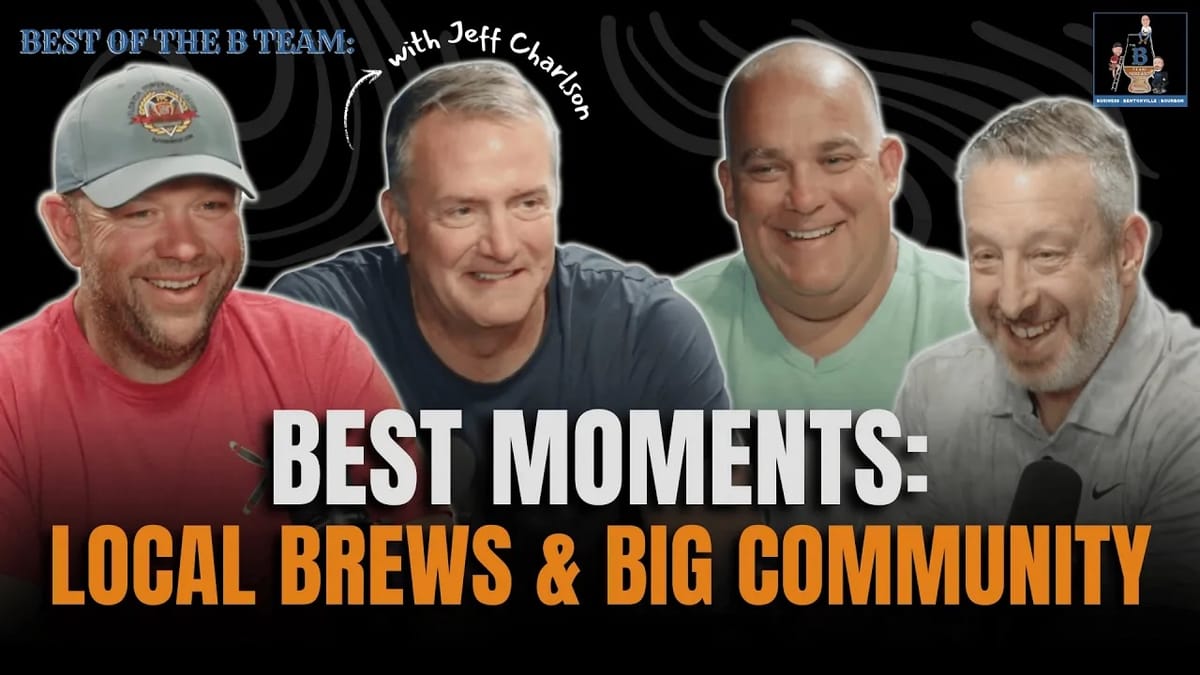
This week on The Best of B Team, we're throwing it back to our episode with Jeff, owner and founder of Bike Rack Brewing Co.
Imagine the sun on your shoulders, a cold pint in hand, and a reason to show up, this conversation lives where small batches meet big community energy. We crack open a limited summer release designed for poolside afternoons and talk about why keeping it scarce pushes people off the couch and out to the farm to taste it fresh. From the first sip, the strategy is clear: let the beer be a moment, not just a product, and pair it with simple, smart marketing that moves people to gather.
We share how a decade in craft beer turned our taproom into a home for local artists, funding albums, pressing vinyl, and turning Friday nights into rehearsal halls for a 90s cover band. Partnerships aren’t a slogan for us; they’re a map. When your front door lines up with a neighbor’s venue, you dream up VIP-only drops and collaborations that feel earned and close to the ground. That same “build with what’s near” mindset led us to a tight, fast food menu: wings done right and a giant pretzel that keeps tables happy without stealing space from tanks in a production brewery.
There’s also the truth about the leap. Home brew praise is kind, but scaling demands process, fermentation control, and a willingness to rewrite plans that once felt perfect. We talk through the gap between optimism and execution, the risk of leaving safe jobs, and the grit it takes to keep learning. On the board, a balanced lineup leads the way: a West Coast IPA named after local trails, hazies for modern palates, and approachable ABVs that invite another round. Along the way, you’ll hear the laughter, the near-misses, and the simple rules we live by: make beers that fit your place, keep the menu sharp, and let community be the headline.
If this story of small-batch creativity and hometown loyalty hits home, you need to see the full episode! Follow the show, share it with a friend who loves craft beer, and drop a review with your favorite taproom pairing, we’re taking notes for the next collab.
More About this Episode
Beyond the Taproom: What Ten Years in the Bentonville Beer Scene Actually Looks Like
When we sit down every week on the B Team Podcast to talk about Bentonville, bourbon, and business, we are usually looking for the "why" behind the local success stories. This week, we took a look back to one of our episodes with Jeff Charlson of Bike Rack Brewing Co. We take a deep dive into a decade of local brewing, and it stripped away a lot of the romanticism people associate with the craft beer industry. We often see the polished final product, the cold pint, the crowded patio, the cool label art, but we rarely talk about the "homebrew naivety" that usually starts the whole engine.
What struck me during our conversation is how much the Bentonville landscape has matured. Ten years ago, the dream was just about making a better beer than what you could find at the grocery store. Today, the conversation has shifted. It is no longer just about the liquid in the glass; it is about how a business integrates into the fabric of Northwest Arkansas. Whether it is through local farm partnerships or supporting the arts, the modern brewery has to be more than a production facility; it has to be a community cornerstone.
The Backyard Trap: Why Good Hobbies Don’t Always Equal Good Business
One of the most relatable parts of our discussion was the "Big Green Egg" analogy. We all have that friend who kills it at the backyard grill and suddenly thinks they are ready to open a five star steakhouse. The craft beer world is littered with people who fell into that same trap. You start in the kitchen or the garage with a five gallon kit, your friends tell you the beer is incredible because it is free, and you convince yourself that the transition to a professional system will be a breeze.
But as we discussed, that is where naivety hits a wall. Moving from homebrewing to a professional production brewery is a seismic shift. You go from worrying about a single batch to managing complex fermentation cycles, distribution logistics, and the high stakes of corporate risk. It takes a certain kind of person to leave the safety of a corporate day job to chase that dream, and as we’ve seen in Bentonville, the ones who survive are the ones who realize early on that they don't know it all. They are the ones willing to fail, iterate, and listen to what the market actually wants.
The Bentonville Ecosystem: Local Supporting Local
We talk a lot about the "Bentonville Way," and this week’s episode highlighted exactly what that means. It’s the idea of the local ecosystem. We saw this in action with the discussion of limited run beers tied to local farm harvests. This isn't about mass production or hitting a huge margin; it is about a week-long window where a specific ingredient is at its peak and the community comes together to celebrate it.
The collaboration goes even deeper when you look at the proximity of our local spots. When you can literally use binoculars to see from one business's front door into another’s, like the new Gent’s Place location, it creates a unique opportunity for exclusivity. We talked about creating VIP experiences and "Gentsgiving" specials that connect the dots between different local hangouts. That is the secret sauce of Northwest Arkansas. It is not just about competing; it is about collaborating to make the town a destination.
Vinyl, Vibrations, and the Arts Community
Something that often gets overlooked in the business of beer is the role of the arts. It was fascinating to hear about the level of investment a local brewery puts into the music scene. We aren't just talking about a guy with an acoustic guitar in the corner of the taproom. We are talking about the brewery actually producing and paying for vinyl records for local artists.
That kind of commitment to the culture, working with people like Neil Greenhaw and Jerad Sears, is what builds brand loyalty that a billboard can't buy. When Jukebox Confession shows up for a three hour rehearsal on the patio, it’s not just "live music." It’s an event. It’s the sound of Bentonville on a Friday night. It creates a vibe that tells the customer they are part of something bigger than a transaction.
Scaling Down for Quality: The Food Evolution
The conversation about food in the taproom was a great lesson in business focus. For a long time, breweries in the area relied solely on food trucks or luck. But the shift toward simple, high quality internal food programs is a game changer. The strategy we discussed, using high efficiency European ovens to minimize space while maximizing output, is a brilliant way for a production brewery to keep people in their seats without becoming a full scale restaurant.
Focusing on just one or two items, like legit chicken wings or those massive pretzels that feed three people, is a masterclass in operational efficiency. It’s the Starbucks model applied to the craft beer world. You don't need a fifty item menu; you just need to make sure that when someone is two beers in and starts feeling hungry, you have a high quality answer that keeps them from walking out the door.
Slaughter Pen: The Beer that Maps the Town
We wrapped up the talk by looking at the staples. Slaughter Pen IPA is more than just a top seller; it’s a tribute to the mountain bike culture that has put Bentonville on the map. It started as a nod to the first trail in town and has become the standard. In an era where "Hazy IPAs" are the shiny new toy, having a consistent, 6.3 percent West Coast IPA as your heartbeat is essential.
It reminds me that while trends come and go, the things that are rooted in the local geography and culture are the ones that last. Slaughter Pen isn't just a beer; it’s the reward at the end of a ride. It represents the active, outdoor lifestyle that defines our listeners and our neighbors.
The Reality of the Entrepreneurial Leap
The biggest takeaway for me this week was the reminder that entrepreneurship is a high risk, high reward game. For every success story we feature on the B Team Podcast, there are a dozen people who took the risk and didn't make it. Jumping away from the man to support yourself is a grind that requires a thick skin and a short memory for failure.
As we look toward the future of the Bentonville scene in 2026, it is clear that the "Golden Era" of just showing up and selling beer is over. The next decade will belong to the businesses that understand the balance between a great product and a deep community connection. It was a great conversation, and it makes me even more excited to see what the next ten years have in store for this town.

Member discussion: