
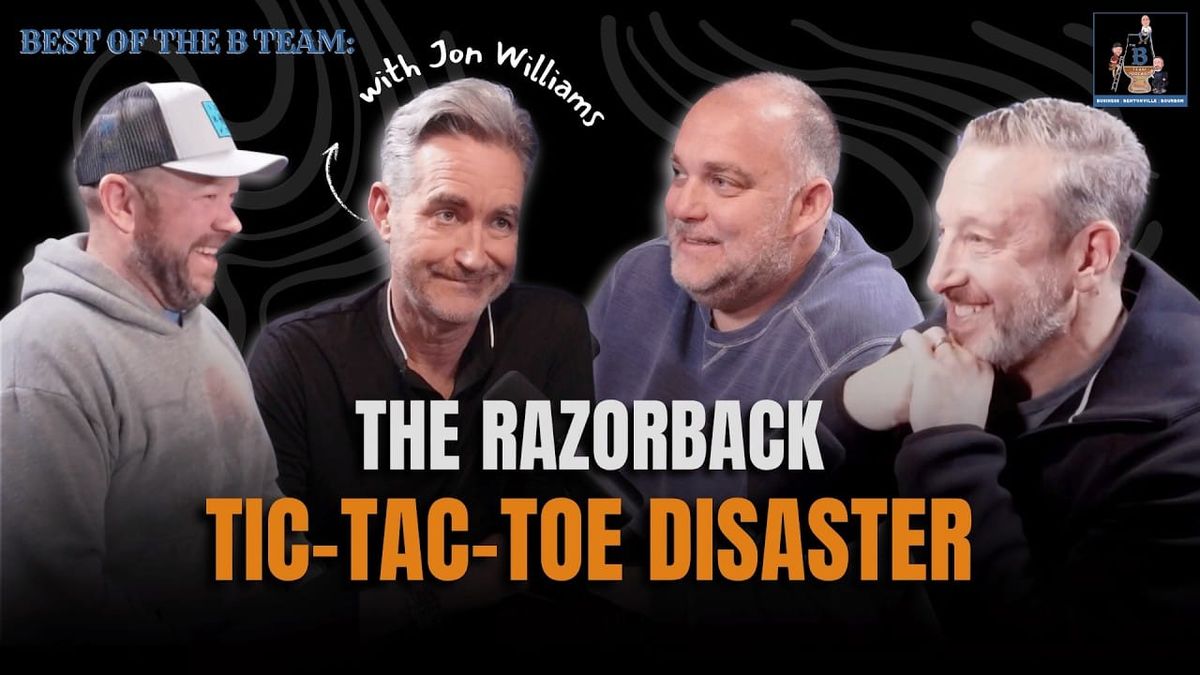
Live entertainment looks effortless until you are the one standing in the center of a stadium with twenty thousand people watching you. The difference between a seamless fan experience and an absolute disaster class in front of a packed arena comes down to split-second ad-libbing. Whether it is managing a corporate-sponsored game on the court or keeping a crowd engaged during a timeout, live media requires a distinct level of comfort with chaos. Today the B Team sits down with Northwest Arkansas media staple Jon Williams to unpack what it really takes to hold the microphone for major regional events and the Arkansas Razorbacks.
We get into the reality of working under modern fan engagement strategies implemented by forward-thinking athletic directors. Jon shares the logistics behind parallel media careers, balancing corporate partner obligations for heavy-hitters like Whataburger and Zips Car Wash against his own independent projects. We cover the cognitive dissonance that happens when regular people try to play simple games like mid-court tic-tac-toe under stadium lights, alongside the exact division of labor required to keep a local radio show thriving for two decades. Jon details his specific philosophy on separating backend station imaging from frontend advertising sales to ensure long-term business harmony.
The unglamorous truth of regional broadcasting is that public failure is part of the job description. Jon opens up about the universal experience of athletic performance anxiety, sharing hilarious personal history about choking on legendary courts from high school gymnasiums to Madison Square Garden. Navigating a thirty-two-year career in the public eye means learning how to roll with the unpredictable nature of live audiences, uncooperative contestants, and the high-stakes pressure of representing major university brands. Listeners will walk away with a grounded perspective on true professional collaboration and a reminder that even seasoned veterans have hit the bottom of the backboard.
More About this Episode
The Art of Live Fan Engagement: Behind the Scenes at Bud Walton Arena and Donald W. Reynolds Razorback Stadium
Stepping onto the hardwood at Bud Walton Arena or walking out onto the turf at Donald W. Reynolds Razorback Stadium is an experience that words can barely do justice. For nearly eight years, I have had the absolute privilege of serving as the on-court and on-field Master of Ceremonies for the Arkansas Razorbacks. Every single game day, looking out at a sea of passionate fans, I find myself deeply grateful for the opportunity to connect with the incredible community of Northwest Arkansas.
The path to this role was not something I actively sought out or auditioned for in a traditional sense. Instead, it was born out of a visionary shift in how the University of Arkansas approaches live fan engagement. When Athletic Director Hunter Yurachek took the helm, he recognized a powerful opportunity to elevate the atmosphere within our sports venues. He wanted to bridge the gap between the action on the field and the energy in the stands by introducing dedicated emcees to lead live promotions and keep the crowd dialed in during every timeout and break.
One day, the athletic department approached me and laid out the vision. They explained that they needed someone to handle live interactions, working directly with corporate partners and engaging the crowd in real time. It was a natural fit for my background, and I jumped at the chance. Since then, the experience has been a whirlwind of high energy, corporate partnerships, and completely unpredictable live entertainment.
The Precision and Perils of Scripted Game Day Promotions
From the outside looking in, game day fan engagement might seem completely spontaneous. While the energy is always raw and authentic, the logistics behind a major collegiate sporting event are meticulously planned. Every single television timeout, halftime show, and pre-game segment is structured down to the second.
Our live promotions are tied directly to major brand partnerships, featuring companies like Whataburger, Zips Car Wash, and Coca-Cola. Whether we are launching the classic Coca-Cola t-shirt toss or organizing a high-stakes halftime contest, we operate within strict parameters. Typically, my team and I are given a specific window, usually between 60 and 90 seconds, to execute a bit, showcase the sponsor, and hand the stadium back to the game broadcasters or the referees.
However, no amount of scripting can prepare you for the beautiful chaos of human nature once a fan steps into the spotlight. Take the Whataburger tic-tac-toe challenge, for example. On paper, tic-tac-toe is a game that most people master by the time they are in kindergarten. The optimal strategy is universally understood: if you win the coin toss, you take the center square.
Yet, when you take an ordinary person, put them on the floor of Bud Walton Arena in front of nearly 20,000 screaming Razorback fans, hand them a basketball, and tell them they have to make a layup before running to midcourt to place their X or O, cognitive dissonance sets in completely.
It is a fascinating psychological phenomenon to witness firsthand. The whistle blows, the contestants sprint down the court, and almost without fail, the first person completely ignores the center square. They will place their marker in a random corner or a side column, and from my vantage point with the microphone, I instantly know we are headed for a hilarious disaster.
The pressure of a massive live crowd causes even the simplest mechanics to completely break down. Contestants will miss wide-open layups, forget their own game strategy, or completely fail to block their opponent when the winning move is staring them right in the face.
My job in those high-pressure moments is to ad-lib and steer the ship. This unpredictable environment is precisely why my three decades of experience in live broadcasting and public speaking come into play. When a promotion goes entirely off the rails, you have to embrace the humor, keep the energy high, and ensure the crowd stays thoroughly entertained.
Choking in the Spotlight: A Universal Human Experience
Whenever I watch a contestant struggle during a halftime game, I feel an immense amount of empathy. The truth is, almost everyone who steps onto a massive stage under bright lights experiences a brief moment of panic where their muscle memory completely vanishes. I know this because I have lived it myself, both as a teenager and as a young adult.
Back in my high school days, I was an incredibly confident basketball player. During our school games, we used to run a fundraising raffle where a ticket was drawn, and the selected student got to shoot a free throw to win the entire pot of pooled money. The catch, of course, was that the pressure usually caused people to choke.
One evening, seeing the pot grow larger, I convinced my group of friends that we should all pool our money for raffle tickets. I confidently told them that if any of our names were called, I would step up and shoot the free throw. At the time, I was a 90% free-throw shooter in practice and a total lock on the court.
Sure enough, one of my friends had their ticket drawn. They yelled for me to get out there, and I walked onto the court with total confidence. But as I stood at the line, looking at the entire student body watching me, my mechanics completely deserted me. My elbow flared out, my knees locked up, and I launched a shot that completely missed the rim. It didn't just airball; it struck the tiny rubber bumper underneath the backboard. To this day, decades later, I still hear about that absolute disaster class of a free throw from old friends.
A few years later, in the late 1990s, I found myself experiencing the exact same phenomenon on an even grander stage. I was attending a New York Knicks game at Madison Square Garden when my number was called to come down to celebrity row and participate in a live shooting contest on the legendary Garden floor.
Once again, I thought my basketball background would carry me through. But the moment I stepped onto that iconic hardwood, surrounded by the history of the arena and thousands of New York sports fans, my legs turned completely to jelly. I forgot everything I had ever learned about shooting form. The shots missed badly, the notoriously tough New York crowd showered me with boos, and I had to walk back to my seat to the sound of my friends laughing hysterically.
These personal mishaps taught me a valuable lesson that I carry into my role as an MC today: the view from the floor is entirely different than the view from the stands. When you are under the lights, the world shrinks, the pressure mounts, and anything can happen. That is why I love interacting with our contestants; they are incredibly brave for putting themselves out there, and the moments where things go wrong often make for the most memorable and endearing entertainment.
Two Decades of Synergy: The Mechanics of a Lasting Radio Partnership
While game days with the Razorbacks provide an incredible adrenaline rush, my daily professional life centers around a different kind of live entertainment. On November 3, 2005, I sat down in front of a microphone at 93.3 The Eagle to host a brand-new radio show alongside my co-host, Dee. This coming November, we will officially celebrate 20 years of broadcasting together as a duo.
In the world of entertainment and media, maintaining a partnership for two decades without major conflict is incredibly rare. Radio duos are notorious for creative differences, ego clashes, and public breakups. People often ask me how Dee and I have managed to maintain a seamless, harmonious relationship for nearly twenty years without ever getting into a single serious argument.
The secret to our longevity lies entirely in our diverse skill sets and a profound mutual respect for what each of us brings to the table. We do not compete with one another because we handle completely different aspects of the business.
Dee is the undisputed creative mastermind behind the sonic identity of our program. He handles all of our station imaging, producing the custom liners, promos, and audio elements that give our show its distinctive flavor. Furthermore, he is the primary curator of our musical direction.
When we launched our current iteration on 94.9, we wanted to build something entirely unique for the Northwest Arkansas market. Our sonic model was inspired by KBCO in Denver, a legendary station known for its world-class rock format. There was simply nothing else like it in our region, and Dee has worked tirelessly to craft a playlist and an on-air vibe that mirrors that sophisticated, high-quality rock sound.
My responsibilities, on the other hand, lie heavily on the business and commercial side of operations. While Dee focuses on the production and the music, I manage our corporate partnerships, handle local advertising sales, and secure the sponsors that keep our show viable and independent. For the past 14 years, this division of labor has allowed us to operate like a finely tuned machine.
By staying in our respective lanes and trusting each other's expertise, we have eliminated the friction that typically destroys creative partnerships. Dee has full autonomy over the sound, I have full autonomy over the business, and when the microphones turn on, we simply get to enjoy the incredible chemistry we have spent two decades building.
The Power of Local Media and Community Connection
Whether I am standing at midcourt in Bud Walton Arena or talking into a studio microphone at the crack of dawn, the underlying mission remains exactly the same: connecting with the people of Northwest Arkansas. Over the last 30 years, I have also had the distinct honor of serving as a master of ceremonies for practically every major non-profit event and charity gala in our region.
What makes this community so special is its willingness to show up. Whether it is supporting a local charity, tuning into a homegrown radio station, or packing a stadium to cheer on the Hogs, the energy in Northwest Arkansas is unmatched.
Live entertainment, at its core, is a two-way street. I can bring all the energy and preparation in the world, but the magic only happens when the audience gives that energy right back. Every missed layup in a halftime game, every laugh shared over the airwaves, and every dollar raised at a local charity auction is a testament to the vibrant culture we have built here.
Looking back at twenty years on the radio with Dee and nearly eight years on the field with the Razorbacks, I am reminded that the best stories are always the ones that are unscripted. It is an absolute blessing to be a part of this community's daily life, and I cannot wait to see what the next season brings.

Member discussion: